
 December 4, 2025
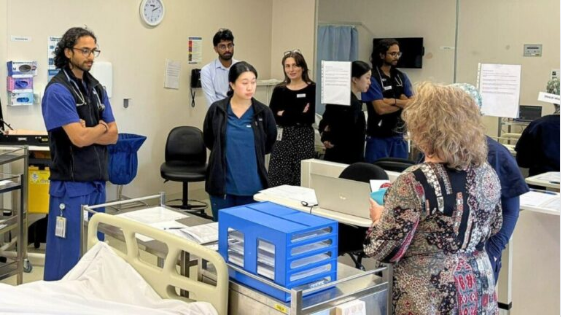
Intern pharmacists from Northern Health and final-year MD4 students from the Northern Clinical School (University of Melbourne) recently took part in an innovative interprofessional simulation designed to prepare them for real-world hospital practice.
Developed in response to participant feedback, the program was created after intern pharmacists reported uncertainty about how to approach medical staff, while medical students identified gaps in their pharmacology knowledge and understanding of the hospital pharmacist’s role.
“Jeff Khoshaba, Lead Pharmacist for Education, and I connected at a recent conference and realised our students shared similar learning needs. This collaboration has not only created a fun and valuable learning experience for them, but also highlighted how interdepartmental collaboration in medical education can benefit everyone involved,” said Pip Wills, Simulation Teaching Specialist, Northern Clinical School, University of Melbourne and Emergency Physician, Northern Hospital Epping.
To address these needs, staff from Northern Health Pharmacy and the Northern Clinical School co-designed a realistic “night shift” simulation, mirroring the fast-paced, high-pressure environment of a hospital after hours.
During the simulation:
- Groups of four medical students rotated through six simulated patient stations.
- They received simulated phone calls from ward nurses seeking clinical advice.
- Intern pharmacists completed ward-based responsibilities and fielded their own calls from nursing staff.
- Both groups were encouraged to collaborate in real time, consulting and problem-solving together—just as they would during an actual shift.
The exercise concluded with a joint debriefing that explored key clinical and communication scenarios, followed by profession-specific sessions to consolidate learning.
Feedback from participants has been overwhelmingly positive. Both medical students and intern pharmacists reported increased confidence, improved understanding of each other’s roles, and greater appreciation of the importance of interprofessional collaboration in delivering safe, effective patient care.
One medical student commented, “Having a pharmacist involved in the simulation made it feel much more realistic. It helped me understand when and how to engage with pharmacists to provide better patient care.”
Ongoing feedback and evaluation will continue to refine the simulation to ensure it meets learners’ needs and reflects the evolving realities of clinical practice.

