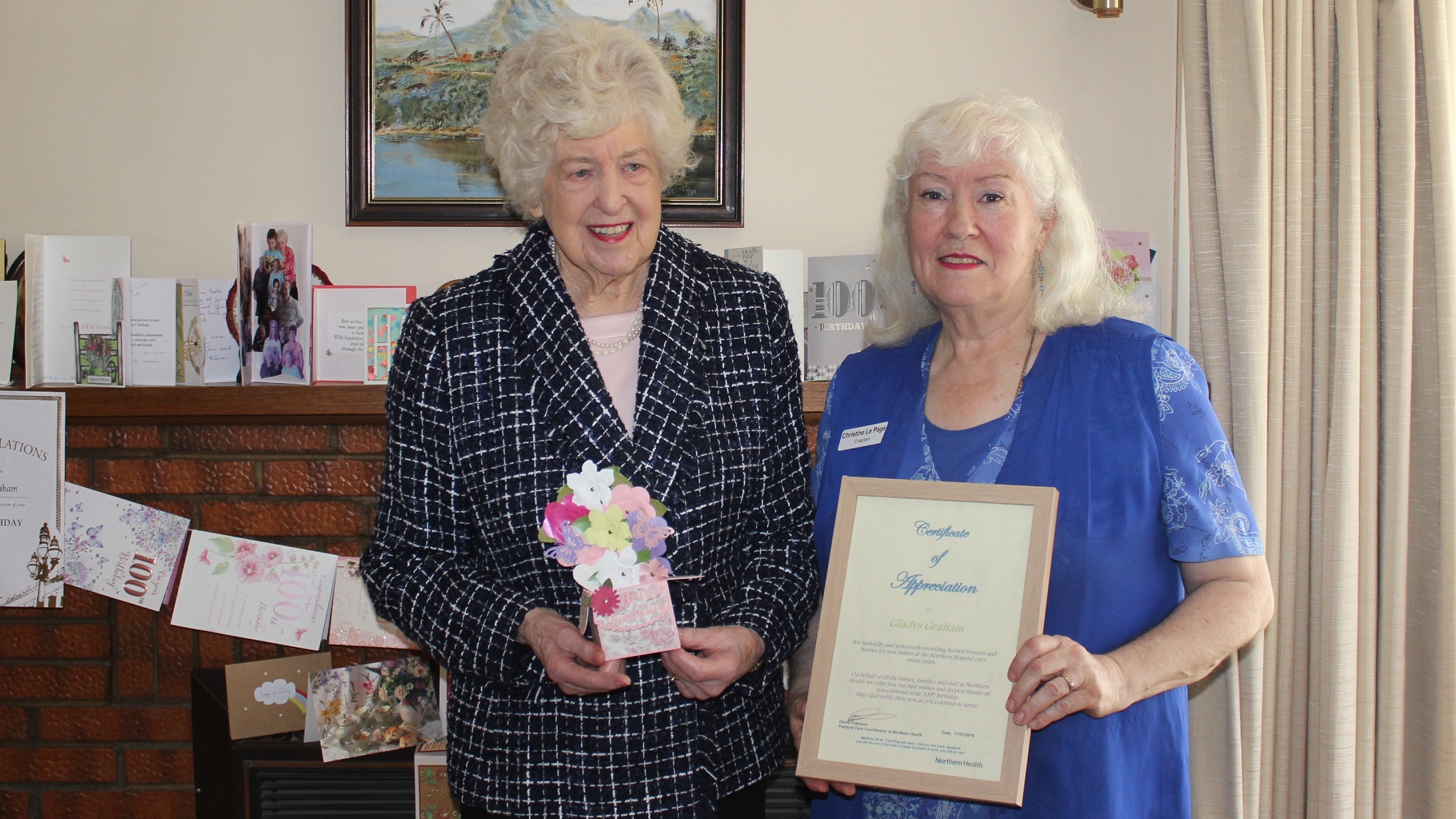
• Gladys turns 100

    Gladys turns 100

    Ten years ago, Gladys Graham’s doctor advised her to put her feet up as often as she could, to help her poor circulation. Most people her age, would have conceded the time had come to take that advice literally and retire gracefully. Not Gladys. It was at the age of 90 that Gladys discovered her ‘second career’ – knitting caps and booties for the babies in our Maternity Services.

    Every month, Chris Le Page, Pastoral Care Worker (pictured here to the right of Gladys), collects six to eight sets of the caps and booties Gladys knits. Chris explained that Gladys originally heard of the need for these items from one of our volunteer chaplains and decided she could help.

    “Gladys pays for the wool herself and knits them with a lot of love,” Chris says.

    Seneca Bowen and Jo Quinn from our Koori Maternity Service, say the midwives, mums and babies love how they are knitted in the Aboriginal colours.

    “It’s fantastic that these hand knitted items can be given to families in need,” says Michelle Morrow, Maternity Services Nurse Unit Manager.

    When we visited her with a signed card and a framed certificate of appreciation from the Pastoral staff at Northern Health, she insisted on sharing her birthday cake with us (a delightful confection, topped by coloured balls of yarn).

    Gladys seemed quite amused by all the attention, including a card from the Queen – “I don’t know what all the fuss is about!,” she said.

    Gladys showed no signs of slowing down and admitted she was ready once again to get back to her knitting – “I want to keep doing it!”

    The Pastoral Services Department provides Pastoral and Spiritual support across all Northern Health sites. The department comprises of Northern Health employees, faith employed Chaplains and volunteer Chaplains.

    As an extension of the in-house team, the Pastoral team also have a variety of ministers, some 50 in total, who provide support after hours to members of their own faith traditions. These dedicated individuals will come in outside of business hours to comfort and support those in need. Communications (formerly NH Switch) have a list for after hours when needed.
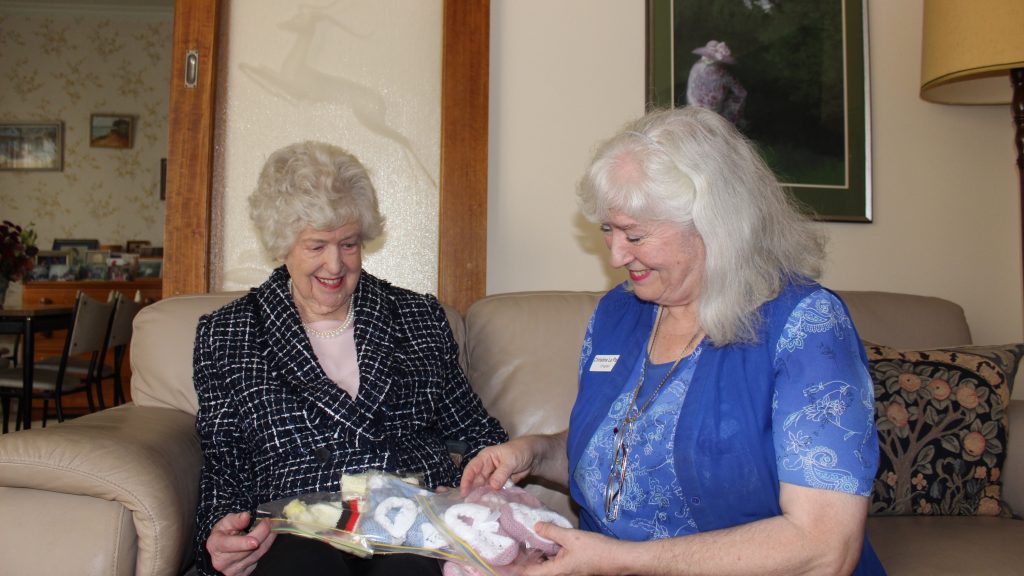
    Gladys Graham on the left with Chris Le Page, Pastoral Care Worker
  • Michelle Fenwick: People Matter Survey 2019

    Michelle Fenwick: People Matter Survey 2019

    Next week, Northern Health launches the 2019 People Matter Survey, which will run from Monday, 13 May until Friday, 31 May. This survey is your opportunity to provide Northern Health with feedback on what is working well and what we need to be doing differently. Your feedback is incredibly important because it helps drive a number of key initiatives.

    Over recent years, some of the key initiatives driven from your feedback include increasing communication through iNews and Chief Executive updates, reviving our Annual Staff Awards and introducing a new Quarterly Staff Reward and Recognition Program. We have a strong focus on addressing bullying and harassment and we’ve aligned to key community action groups such as White Ribbon. We’re currently improving our People Management systems and establishing an integrated Help Desk. Other initiatives include staff safety programs such as Mental Health Week, Fatigue Management and supportive programs like Pilates, Mindfulness and Financial Wellbeing.

    The more staff voices we hear from, the richer the feedback, which in turn, assists us with raising ideas and more importantly, what needs to change to ensure that Northern Health is truly a great place to work.

    On the morning of Monday, 13 May, all Northern Health staff will receive a generic survey link, which is sent to all active email accounts. The survey link means you can complete the survey anywhere, any time of the day and on any device that has Internet access and will take approx. 15 minutes to complete.

    It’s also important to note that we take your privacy seriously and therefore, the survey has been and is completely anonymous. The survey is managed by an external company (Orima) and Northern Health will only receive an aggregated (and de-identified) report.

    In 2018, 47 percent of Northern Health staff completed the survey, this year we want to hear from even more of you!

    We look forward to receiving your responses and sharing the results from this year’s survey. If you have any questions about the survey, please contact Penelope Grellet (Penelope.grellet@nh.org.au).

    Michelle Fenwick

    Executive Director, People and Culture


  • Nurses and Midwives Week: Clemente Meulio

    Nurses and Midwives Week: Clemente Meulio

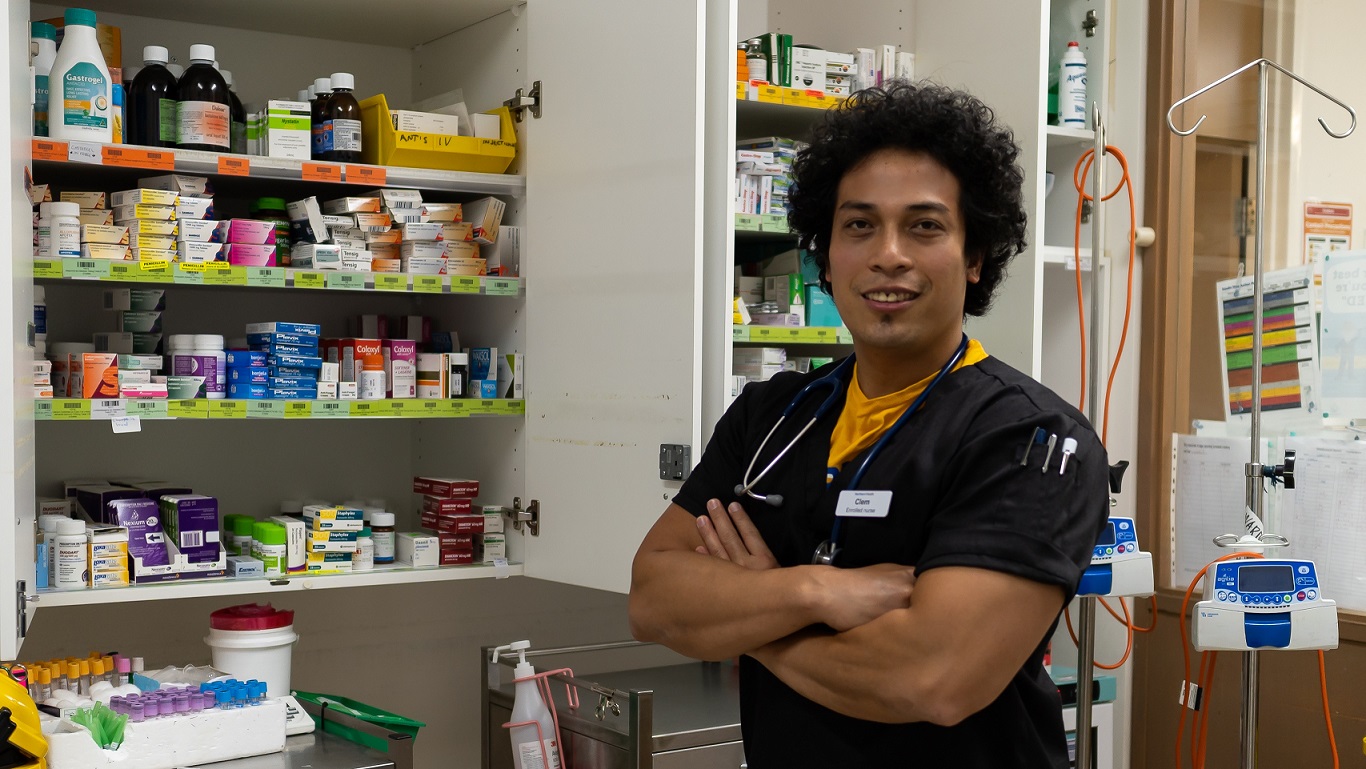
    Whilst working as a food services assistant, Clemente realised he wanted to become a nurse, after being inspired and seeing the work nurses do.

    “Besides this, my family members are also nurses, so I studied at RMIT to become an enrolled nurse,” he explains.

    After graduating in 2011, Clemente landed his first role at Bundoora Centre as an enrolled nurse on Ward One.

    A year later, he got involved with geriatric evaluation management and got offered a management role as a novice coordinator.

    “In this role, I advocate for safety of patients and staff, work on orientation for new staff and look after proper care of patients. I’ve also become an OHS coordinator and, at the time, felt that I reached the peak of my current career,” he said.

    Being proactive and ambitious led to Clemente continuing his studies to become a registered nurse, and in 2016, he enrolled at Charles Darwin University in an Undergraduate Nursing Program.

    “After graduation, I got an offer to join the Graduate Nurse Program at Northern Health and I am looking forward to starting in the cardiology unit in May this year,” he added.

    Clemente feels the best side of nursing is achieving the best possible health outcomes for a patient, and developing a connection of trust with the patients, especially in cases where a patient suffers from depression.

    Outside of work, Clemente has many creative interests and a huge passion for photography.

    He adds that he actively trains at least four times a week at the gym to maintain work/life balance, and loves travelling.

    Clemente has exciting plans for the future and, in the next five years, hopes to gain more experience especially in different acute settings.

    “I am doing my first rotation in the cardiac ward and I’m hoping to get into the emergency department (ED) on my second rotation. After my graduate rotation, I would like to do a step program to work in ED. I am also looking to do a Cert IV in Assessment and Training to be able to do an educator role, as I love educating student nurses. I plan on doing an Associate Nurse Unit Manager role in the future or eventually work in Hospital In The Home (HITH),” he adds.

  • Research Grand Round: Debra Nestel

    Research Grand Round: Debra Nestel

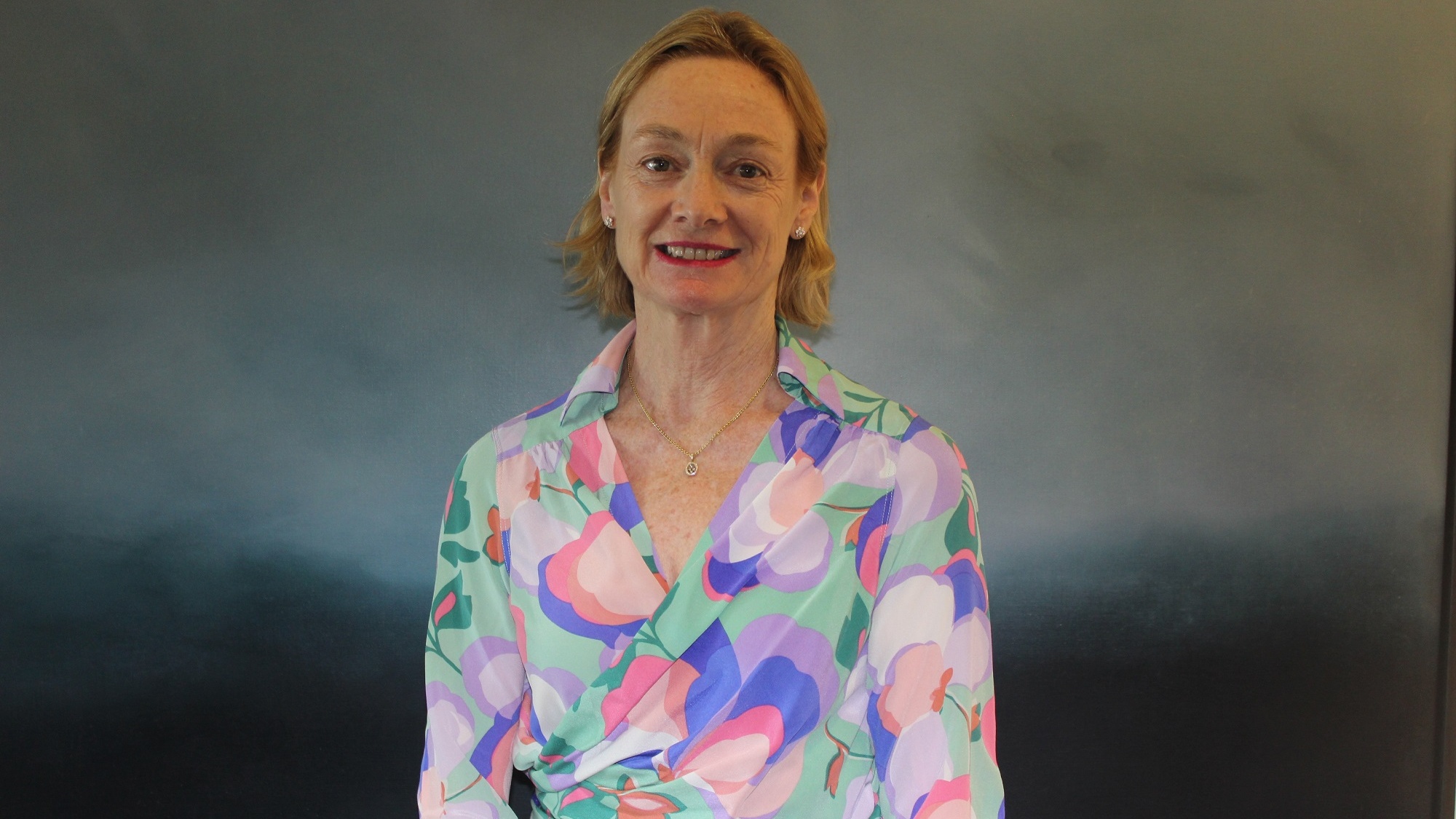
    Professor Debra Nestel is passionate about simulation and says she just fell into that space, but feels that we all use simulation as play when we are kids, we just call it something different.

    “I got exposed to different types of simulation modalities at the Imperial College in London, where I’ve spent 15 years. There, I was in the Department of Surgery where I was exposed to simulation to teach operative and procedural skills,” she explained.

    Together with a colleague, they developed a new approach to simulation to help trainers teach procedural skills.

    “For example, if you are learning to stitch, you can do that on a piece of simulated flesh, but what we did was put that piece of simulated flesh on one of the live simulated patients. That is how the clinicians started to integrate not only the psycho-motor skills, but also to be able to communicate effectively with a patient,” she added.

    She has been in simulation ever since and has built a successful career.

    At Northern Health, her presentation focussed on a couple of key points.

    “The simulation is complex – people often talk about simulation like it’s one thing, but it’s actually many things. It’s important that we articulate the type of simulation we are talking about and where we are using it. I’m also speaking about healthcare simulation research and the landscape and selecting pieces that are really interesting,” she added.

    “The third point I would like to touch on is that evidence also comes in all shapes and forms. There is theory-based evidence, and also experience-based evidence and we should be open to all those types.”

    Professor Peter Brooks, Northern Health Research Lead, added this was a great opportunity to hear and learn from Debra’s expertise, as Northern Health has a simulation laboratory which could be used in new and creative ways.

    “Besides student training, we could be doing so many other things and that is what Debra would be talking about today,” he said.

    He added that he is looking forward to hearing more about doing research from an educational perspective, adding education is not researched enough.

    “Debra is one of the world leaders in this area and based in Melbourne, so we are lucky to have her present. I’d say Victoria, as a state, has more simulation expertise than other states and Northern Health is proud to have a really good facility,” he said.

    Debra’s presentation at Northern Health’s Centre for Education and Research included a workshop with our staff, during which they presented case studies, followed by a lecture.

    Professor Debra Nestel is a Professor of Simulation Education in Health Care at Monash University, and Professor of Surgical Education, University of Melbourne. For over 25 years, she has used simulation as an educational method in the context of health care. Professor Nestel has a particular interest in human-based simulations and is experienced in research and development of several simulation modalities.

  • Nurses and Midwives Week: Gary Lloyd

    Nurses and Midwives Week: Gary Lloyd

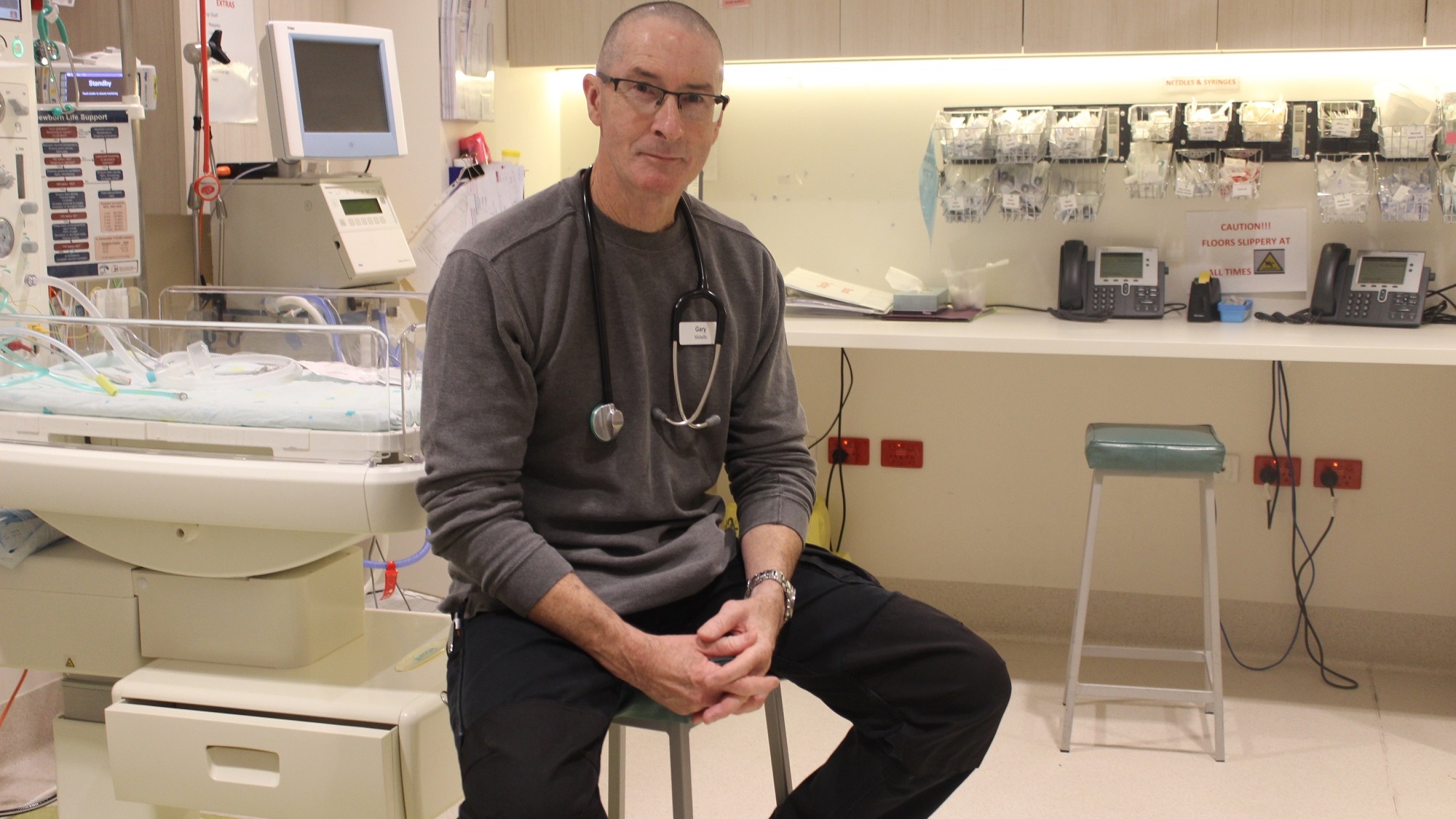
    Gary Lloyd is the only male midwife at Northern Health. He loves what he does, having chosen this career over many other nursing opportunities and finding he can make a real difference in midwifery.

    “During my training, I got exposed to all different areas, like ICU and ED, but eventually I felt that I wanted to specialise and focus on an area,” he explains.

    During his time in the ICU, Gary realised that he would like a role where he would have the opportunity to connect with patients and get to know them better.

    “After I trained in gynaecology and midwifery I realised I really liked it. Everyone was happy – there were cigars all around and chocolates! Everyone is always grateful for the work that you do, and I really enjoyed it,” he adds.

    Gary started at Footscray Hospital in 1992 and for the last three years, Gary has been at Northern Hospital Epping.

    “I just get the best vibe here, it’s just a nice place to work,” he said.

    Gary says the best part about his job is that it’s not really a job – “I come here to have fun and deliver babies at the same time.”

    He adds that he loves the multiculturalism at Northern Health, treating a variety of patients, and the team he works with, as they find time to have fun at work.

    His advice to other male midwifes?

    “Shave your heads. Because the babies pull your hair!”

    “As a male midwife, I try to use humour and win over the dads, and that’s how I win over my patients too,” he explains.

    Gary feels this is a great career choice for men who show kindness and empathy and want to take care of others, as well as show cultural sensitivity and respect.

    “Sometimes it does take a while, but I do win over my patients, regardless of their cultural backgrounds. What matters to me is that my patients feel comfortable during the delivery,” he adds.

    Northern Health is celebrating Nurses and Midwives Week with a range of events and a “Guess the Nurse/Midwife” competition. Head to the ground floor hallway of Northern Hospital (near the lifts) to see the display and win one of three prizes.

  • Epping Football & Netball Club visit Northern Hospital

    Epping Football & Netball Club visit Northern Hospital

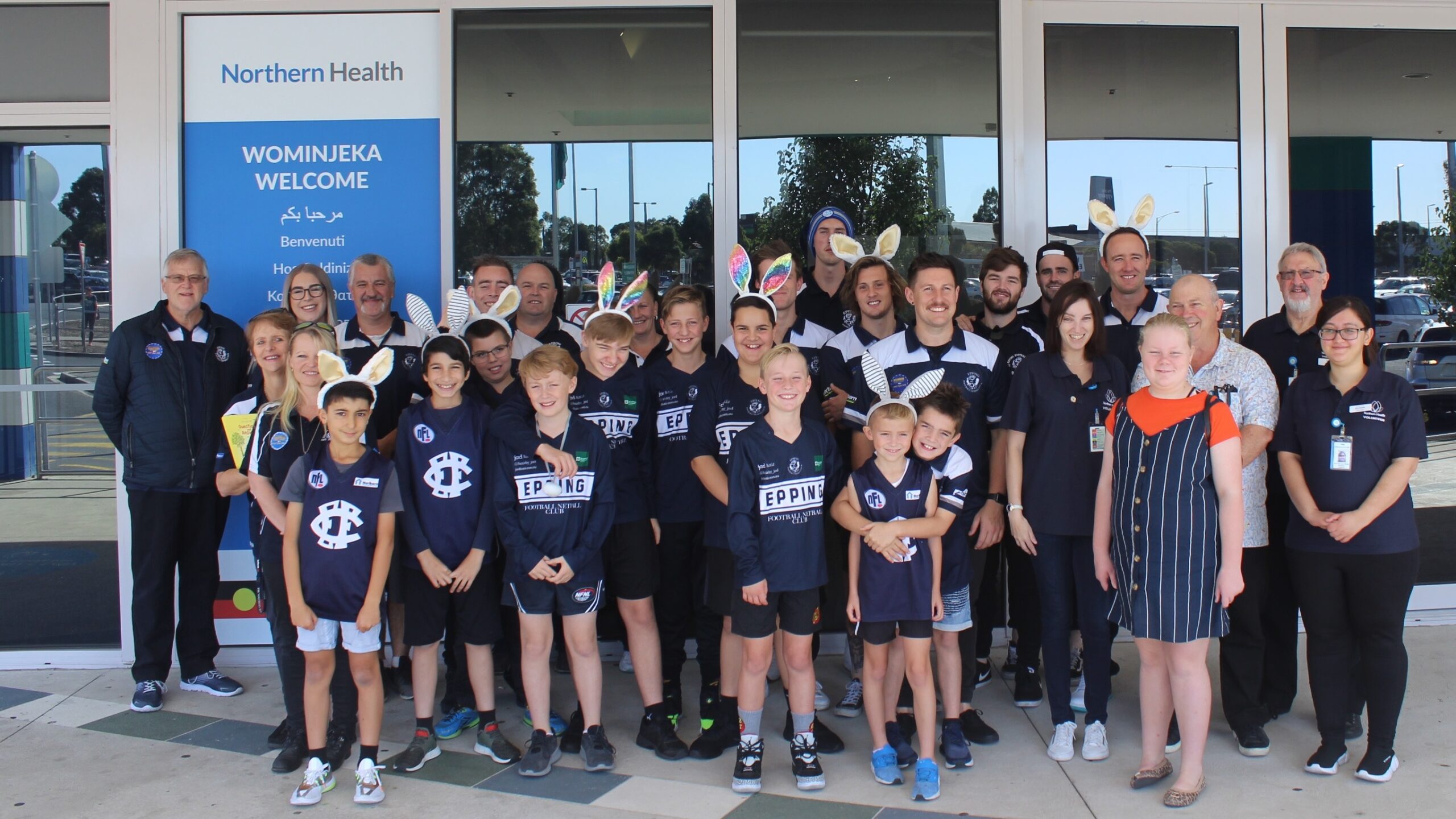
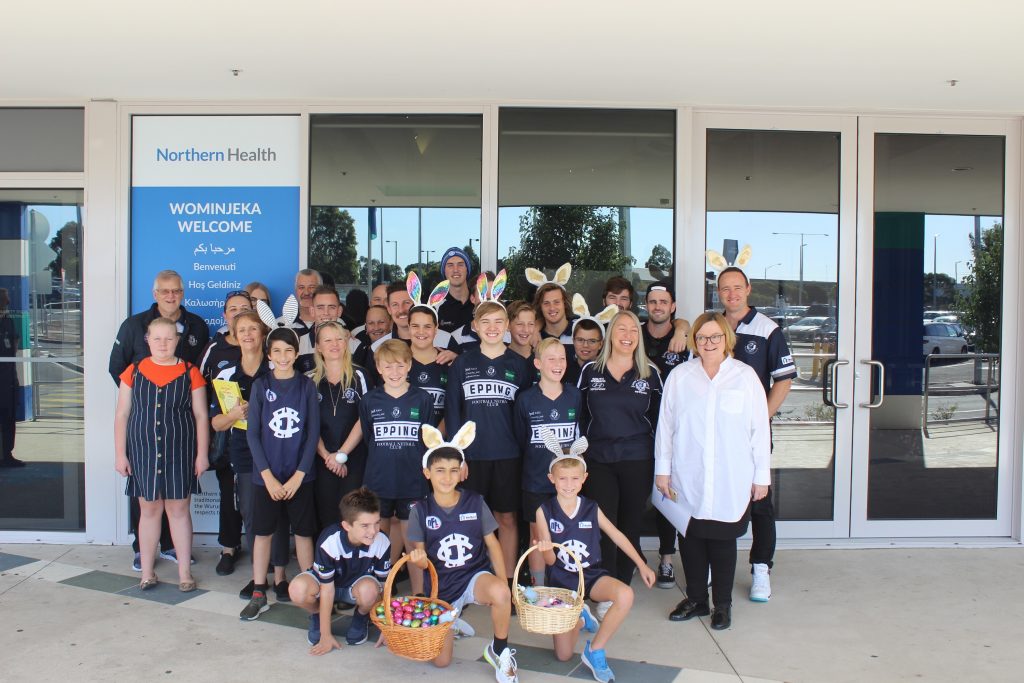
    On Good Friday, 18 April, Northern Hospital patients and staff were treated to a special visit from the Epping Football and Netball Club (EFNC).

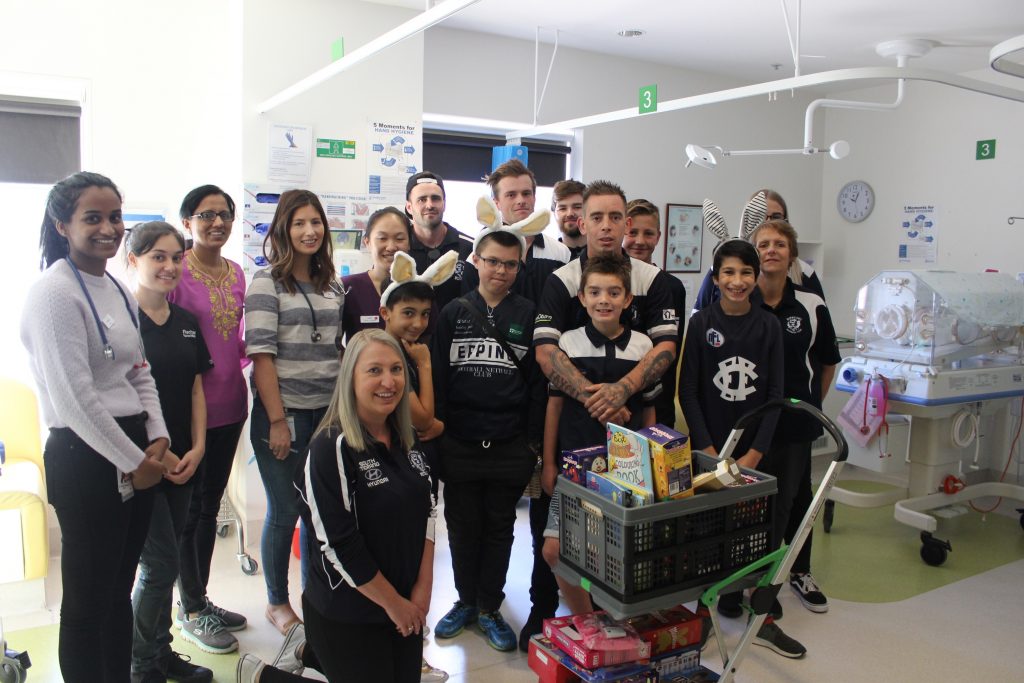
    Both senior and junior players, along with committee members, joined forces to deliver Easter chocolates and smiles to patients in the Neonatal Unit, Children’s Ward and Paediatric Emergency Ward, and engage with staff and visitors at the hospital.

    Community Engagement Officer/Sponsorship Manager of the club, Belinda Urbani, said EFNC are proud of what they do, both on and off the field.

    “Many of our players, both senior and junior, have spent time here at the Northern Hospital, so giving back to the community is very important to us.”

    Yvonne Amos, Northern Health Foundation Director, thanked the players and staff for taking the time to visit Northern Hospital.

    “Having the Epping Football and Netball Club visit here today has helped to brighten the day of many sick children and our busy staff,” said Ms Amos.

    Over 20,000 patients presented to the Northern Hospital Paediatric Emergency Ward last year (Jan – Dec 2018), with over 5,000 admissions to our Neonatal Unit and Children’s Ward.

    EFNC would like to thank families who donated chocolates from Auskick, Woolworths Pacific Epping, IGA and Greenbrook.

    EFNC players with Yvonne Amos, Northern Health Foundation Director
    EFNC players with staff from the Neonatal Unit
  • Get to know Quality Coordinator Sarah Rexhepi

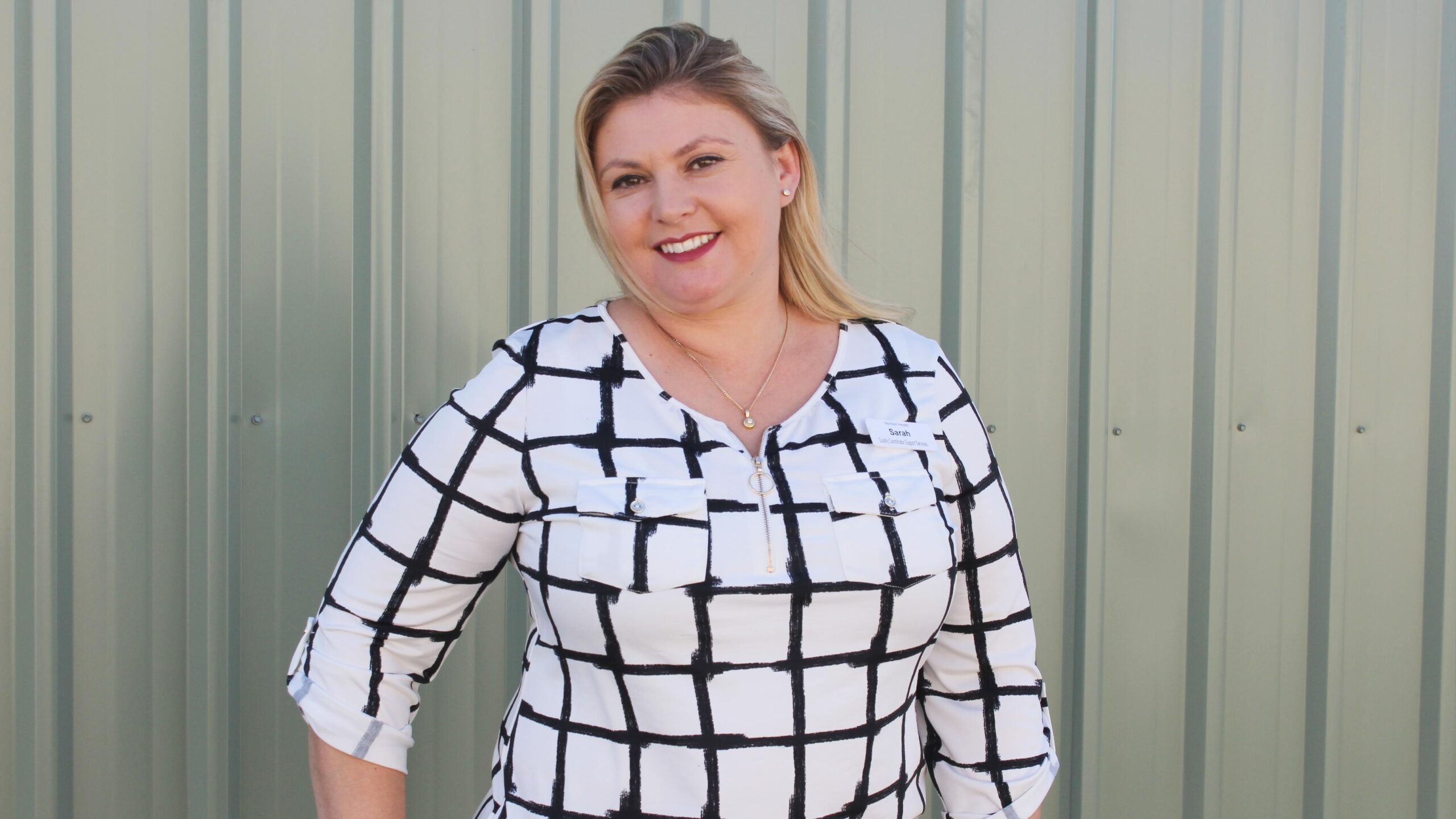
    Get to know Quality Coordinator Sarah Rexhepi

    When Chief Executive, Siva Sivarajah, enquired from Sarah Rexhepi, Quality Coordinator, how she was and if she was busy, she responded saying, “No, I never use the word busy because I don’t like it. We are all here to work – some days can be busy, but not every day, but that’s the first thing that comes out of everyone’s mouth regardless if they are busy or not.” Needless to say, he was impressed by her response. In today’s article, Sarah talks to us about her unique outlook on work, and why she loves her job so much. 

    Firstly, what is your coffee order?

    Soy mocha!

    Can you tell us a bit about your Northern Health journey?

    My journey started in 2005 – 2007. I used to work at Bundoora and then I left to become a flight attendant, but it became really hard with the kids and the shifts. A job opportunity came up here for a Cleaner/Team Leader and I became a supervisor and stayed for just under three years. Then I applied for Support Services – when I was successful it was like I won Tattslotto! It was something I really wanted to do! So I became a Quality Coordinator and Trainer.

    It’s been a great journey but now I think I’ve found my home, because I’ve got great support here, great management and team in general – and I’m happy to come here every day. My colleagues and I have a good time, and we get a lot of things done – a lot of planning, and kicking a lot of goals.

    What do you like most about your role and what do you find most challenging?

    I like that I’m respected in my role and I like being part of a team. I’m involved in the team, which is something I’d never had the opportunity to do. I feel like my opinion is valued and it means something. Coming to work every day is really great because I enjoy it – it actually makes me happy coming to work every day because it’s a great group of people.

    I get to walk around the hospital all day and meet new people and find out what’s happening, how we can improve and what we need to improve. I get my hands dirty, if we have to fix a machine or move beds – whatever it takes – I’m more than happy to help.

    The most challenging part of my role is when people are negative – it’s hard to change attitudes from negative to positive. I think if everyone had a more positive attitude, we would work better. I always talk to people and say we’re lucky to work here, so we have to respect our job and represent the hospital. If we change negatives into positives, everything works.

    What does a typical day look like for you?

    I come in really early at around 6.15 am and read my emails quickly. Then we do a morning huddle with a few PSA’s and have a chat about what happened yesterday, what we will do today and any news – just a general conversation. After that, I walk around the hospital and go through the wards and see what the other staff are up to, see if anything’s wrong and how we can problem solve it on the spot. In the afternoon, I’ll do more auditing through the hospital. There’s a lot of meetings but it’s good because we try to kick goals with our meetings so we have a percentage of how well we’re doing.

    How do you relax after a long shift?

    I do have two teenagers, so…relaxing?

    I think it’s getting a bit easier as they get older. I’ve gotten my son into Married at First Sight, so we sit together and watch it and I can get him off the Playstation a bit.

    Other times, we go to the arcade, play basketball – I’ve got a 13-year old son and a 16-year old daughter – and we catch up with friends or family and just switch off.

    What are some things people don’t know about you?

    I’m always looking on holiday travel websites, always planning my next holiday. Also, I like to draw and I’m always creating – I used to paint in my younger days. I used to play a lot of sports and still occasionally play tennis.

    Sarah’s horror-themed Year 12 painting

    How would you describe Northern Health in one sentence?

    Challenging – the hospital is growing, so there’s a lot of challenges ahead but hopefully we can all make it a better place.

  • Flu vaccination launches today

    Flu vaccination launches today

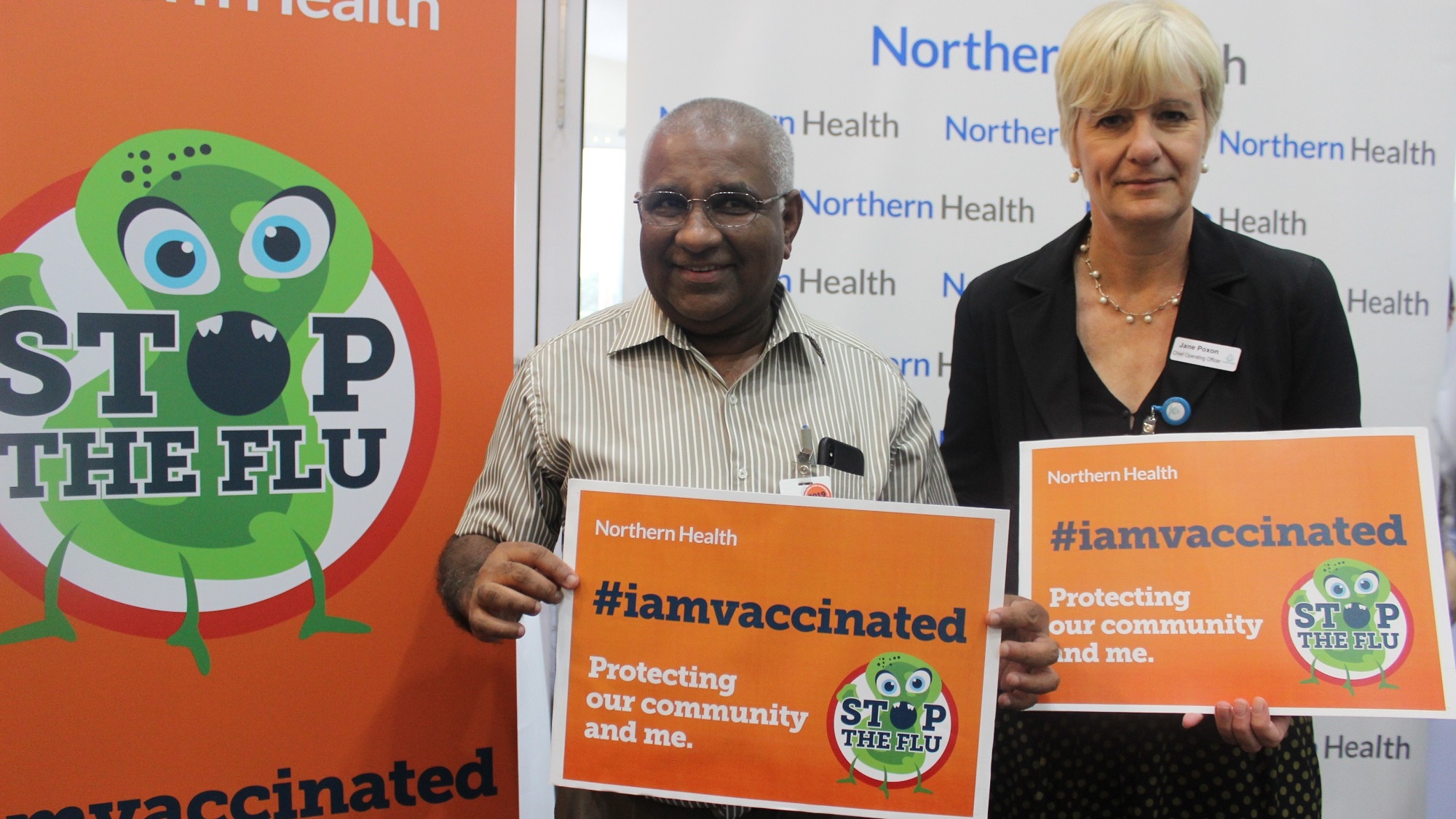
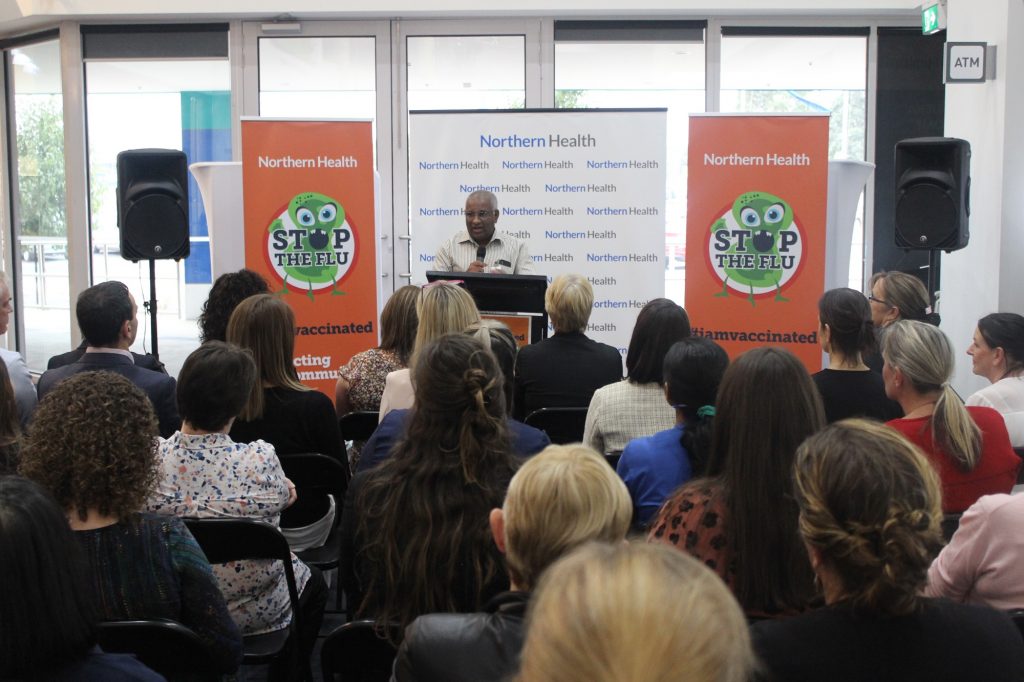
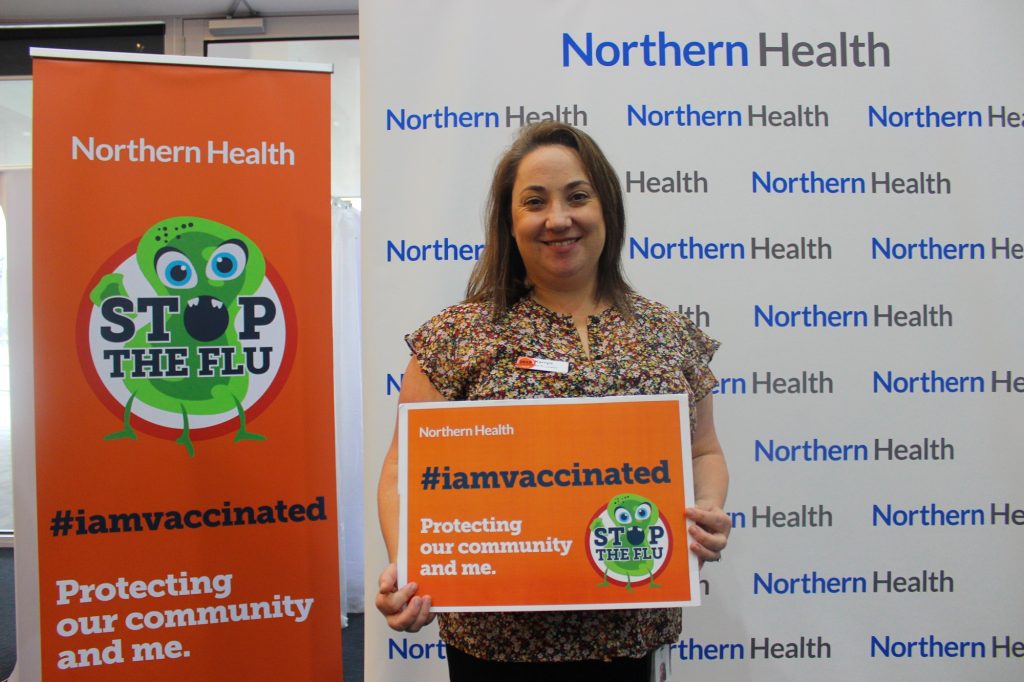
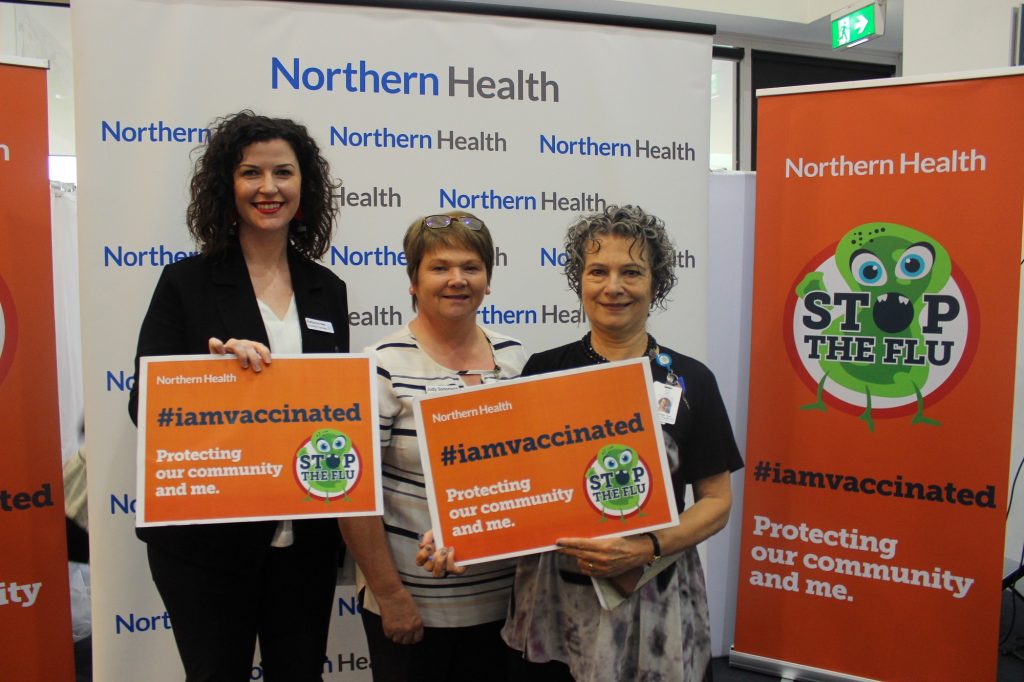
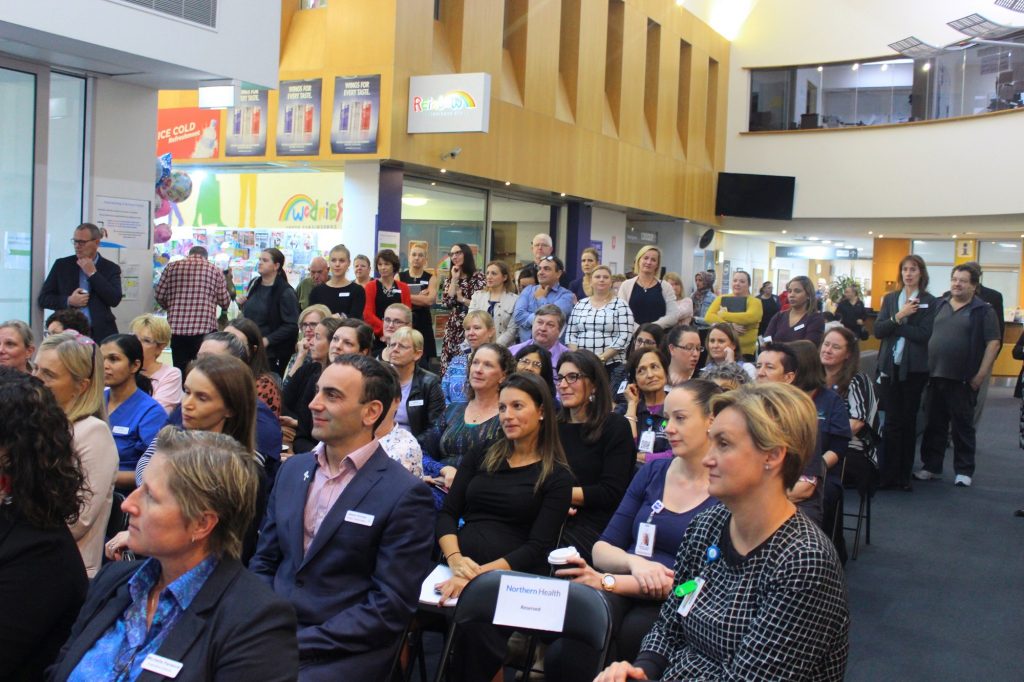
    Today, Northern Health launched the 2019 Flu Vaccination Campaign in the Northern Hospital foyer.

    Siva Sivarajah, Northern Health Chief Executive, said that anyone can be affected by the flu, that’s why it is so important that everyone in the community protects themselves against the flu this season and takes steps to protect their own health and wellbeing, as well as those around them.

    “If we look at the number of staff vaccinated last year, we succeeded in vaccinating over 90% of staff within three weeks of the campaign. That was a record number for Northern Health, and made us third in the state,” he added.

    Dr Katharine See, Head of Respiratory Medicine, said that already this year, we are seeing higher than usual numbers of cases of influenza.

    “Having the flu shot significantly reduces the risk of you getting flu and is recommended for all members of the community. Northern Health is committed to maintaining the health and wellbeing of our community, and is providing free vaccines to all members of our community,” she added.

    Kerryn Asbury, Clinical Nurse Educator at Northern Health, shared a personal story about her husband Trevor, who caught the flu only a couple of weeks ago and had to be admitted into the Intensive Care Unit (ICU) for treatment.

    “We have been told it will likely take another two to three months for Trevor to fully recover and return to work. It’s not just the physical effects of the flu that have impacted Trevor, but the emotional, psychological and financial effects felt by Trevor, myself, our three boys, family and friends,” she added.

    Kerryn strongly encourages everyone to get their free flu shot this year.

    “My husband was not in the high risk category being a 36 year old fit, healthy man. And yet, he was severely impacted by contracting the flu.”

    Pictured above: Chief Executive, Siva Sivarajah and Chief Operating Officer, Jane Poxon.