

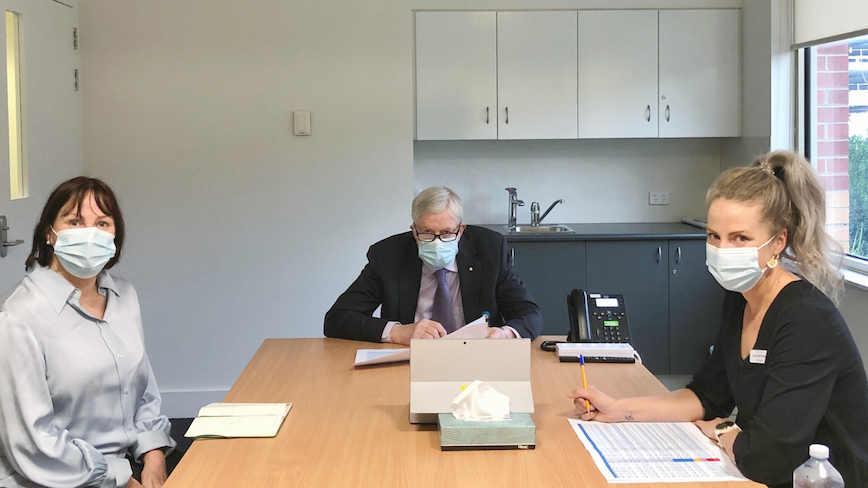
Northern Health staff are constantly adapting the way we conduct ward rounds to meet new and changing circumstances constantly. With the implementation of our Electronic Medical Record (EMR), the primary function and purpose of the ward rounds will not change with the EMR, but the tools our staff use to access and document information will be different.
Currently, we may refer to various paper forms, such as medication chart, plan of care, and observation chart for decision making. One of the benefits that the EMR will bring is a more streamlined process of information retrieval. Other than holding information from all treating clinicians, data recorded on some devices will also be fed into the EMR. The patient data will be presented in a summary screen that displays the most important information about the patient. In cases where our clinicians would like more in-depth information on the patient, they will have the ability to drill down into the details about the patient’s condition and treatment by using the system.
“Being able to access the EMR in real-time as we discuss the long-stay patients in the virtual LOS Round will be very useful, as viewing the most current information will allow us to understand more about what needs to be achieved in order for the patients to be safely discharged,” says Lorinda McPherson, Manager, Acute to Community Coordination Team.
While this change will bring significant benefits in terms of accuracy and breadth of information, as well as legibility, there will be significant adjustments that will take time and practice for us to feel comfortable using the EMR. Patient data documentation will no longer be on paper forms, especially for our wards. Instead, we will have a workstation on wheels (WOW) or a laptop on a trolly to take to the patient’s bedside to enter information. However, with this change, we will need to practice to work out the best way to enter information, view the electronic record and make eye contact with the patient and our team.
Catherine O’Connell, EMR Clinical Documentation Analyst, says from her previous experience in using WOW at the bedside at Monash Health, the transition was beneficial for both the patient and the clinicians, but it will take some time and patience to get used to.
“I found small tips such as letting the patient know what I was doing and placing the WOW to the side and not directly between the patient and I were very helpful in the transition. Once you get used to documenting in real-time, you will never want to go back as overall, the benefits greatly outweigh the inconveniences,” says Catherine.
To help our staff to become more comfortable with the EMR, the EMR team will provide training in how to use the EMR, with practice opportunities such as walkthroughs to familiarise with the equipment and technology, as well as the practicalities of moving around the space and paying attention to our body language.
Dr Richard King, Executive Physician, says the LOS Round was successful despite lockdown. “We would not have been able to carry out the LOS Round during lockdown without the help of digital technology. It was extremely successful and I would like to thank the nursing staff and registrars for their support in making this possible.”
“It was exciting to see how technology had enabled us to conduct virtual ward rounds. We were able to involve key clinicians who may be working from home due to the current COVID-19 situation. I believe with the introduction of the EMR, this could contribute positively to improving our future ward rounds,” says Laura Hughes, Project Manager, Project Management Office and HRO Transformation Unit.
Featured image (left to right): Dr Sandra Brown, Divisional Director, Sub Acute and Aged Care, EMR Medical Accountable Leader; Dr Richard King, Executive Physician and Lorinda McPherson, Manager, Acute to Community Coordination Team