

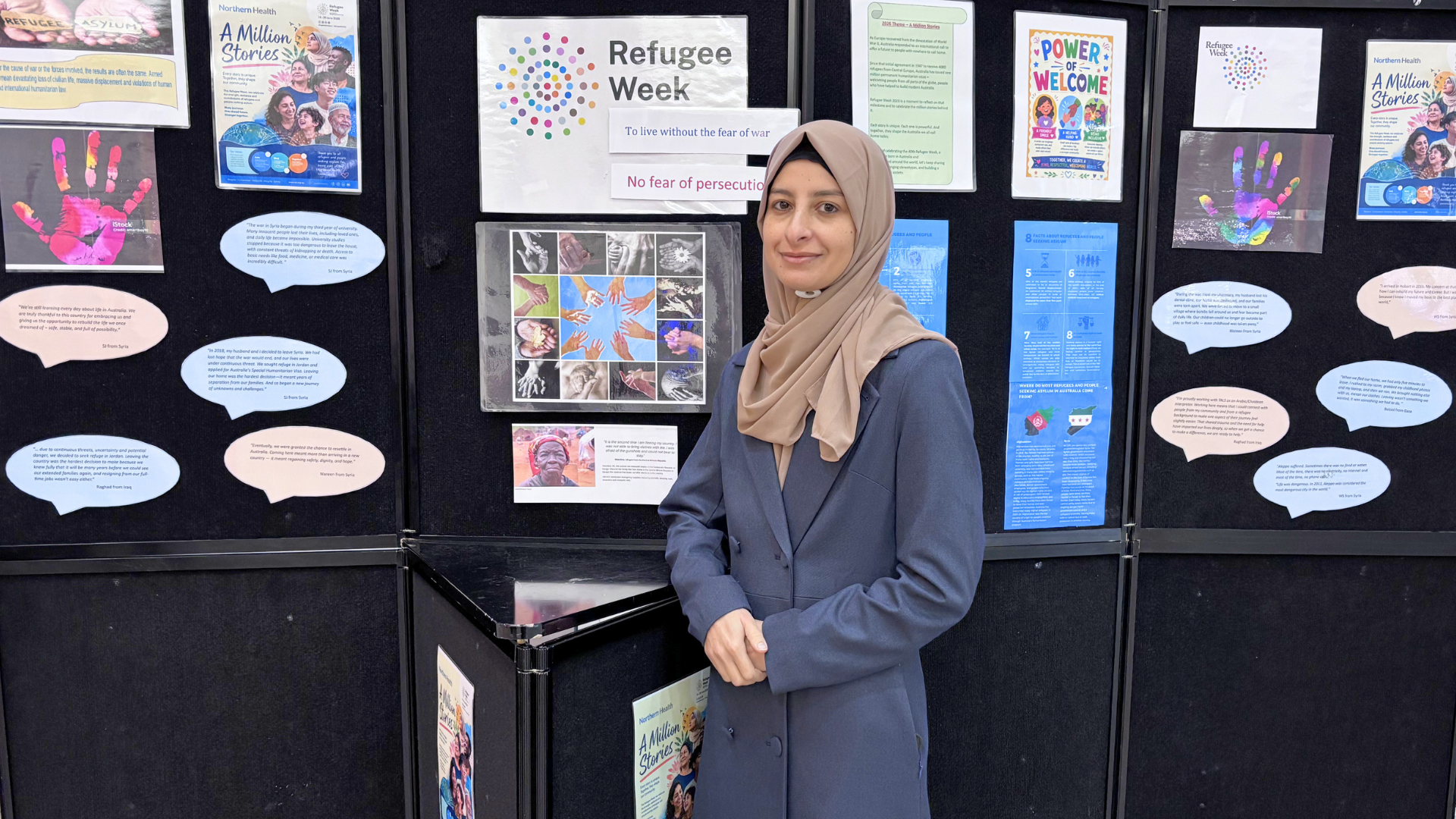
This week marks Refugee Week (15–21 June), an important opportunity to pause, reflect and come together in support of those who have been forced to leave their homes in search of safety, dignity and a new beginning.
Behind every statistic is a human story of courage, loss, resilience and hope. This year’s theme, “A Million Stories”, marks a significant milestone in Australia’s humanitarian history, celebrating the one million permanent humanitarian visas issued since 1947.
Jason Cirone, Chief Allied Health Officer and Chair of Northern Health’s Equity, Diversity and Inclusion Committee, shared, “During Refugee Week, we are reminded of the adversity faced by many new Australians who have left their home countries, often leaving behind family, possessions and sometimes careers. I am continually inspired by the resilience and strength of the many refugees I have the opportunity to meet.”
This year, we are honoured to share a lived experience story from a member of our community, Dr Nour J A Ismail, who presented her journey at three sessions held across Northern Health this week for interns, HMOs and at Grand Round. Dr Nour’s story offers powerful insight into the realities of displacement, the challenges of starting again, and the transformative impact of support, kindness and resilience.
“I arrived in Melbourne on 7 April 2024 with my small family after a 24-hour journey, fleeing a war that had destroyed our homeland and changed our lives within only a few months. I left behind my family, friends and my professional career as an internal medicine specialist, arriving in Australia carrying fear, loss and hope for a new beginning.
The beginning was not easy. I had to adapt to a new language, a different system and an unfamiliar life while constantly worrying about the family members I had left behind. My husband, who had previously worked as a company manager, took a job in a meat processing factory and worked long hours to help us survive, while I began the long and difficult process of having my medical qualifications recognised in Australia.
At the same time, my child was struggling with speech delay, severe fear of sounds and ongoing health issues, requiring constant care and attention. I found myself torn between my responsibilities as a mother and my professional ambitions. Six months after arriving, I sat my first medical exam and passed on the first attempt, but I soon realised that my child’s physical and emotional wellbeing needed my full attention.
Later, I began preparing for the English language exam. During this period, my health declined, my husband underwent emergency surgery, and we had to move to a new home. I failed the listening section twice and felt overwhelmed and discouraged, especially when exam bookings became almost impossible to secure after changes to the testing system. Despite this, I continued trying until I finally found an available spot and successfully passed the exam.
During this journey, I had the opportunity to meet Dr Naba Al-Fayadh, the founder of Rahma Health, and I began working with the organisation as a research assistant. I conducted interviews, provided translation and contributed to data analysis for research evaluating Rahma Health’s services within the Arabic-speaking community. Through Rahma Health, I was able to reconnect with people, communicate, participate actively in the community and regain a sense of identity and purpose. Most importantly, it reminded me that despite all the challenges, I still carried my identity as a doctor.
Afterward, I started applying for hospital positions but faced repeated rejection, as entering the Australian healthcare system is particularly difficult for internationally trained doctors. Although many people advised me to move to rural areas where opportunities were greater, I hesitated because we had only just begun rebuilding stability in Melbourne.
Today, two years later, much has changed. My husband now works as an operations manager in a non-profit organisation, and my son has become more confident, speaks both Arabic and English, and happily attends kindergarten. As for me, I now work with community organisations while continuing to pursue my medical career, and I have started applying for positions in rural hospitals.
My journey has been filled with loss and challenges, but it has also been a journey of resilience, hope and determination to rebuild a new life despite every difficulty.”
As we reflect on Dr Nour’s story, and the many others like it, may it encourage us to continue building a workplace and community grounded in empathy, respect and inclusion. Every story matters, and by listening to and learning from lived experiences, we strengthen our commitment to providing compassionate, culturally safe care for the diverse communities we serve.
You can visit the Lived Experience Library on LMS for more stories that offer insight, understanding and inspiration.

