• Standard 6 – What you need to know

    Standard 6 – What you need to know

    Each week in the lead up to Accreditation, Northern Health will focus on a different Standard. You will hear from the Chairs of each Standard Committee on what you need to know.

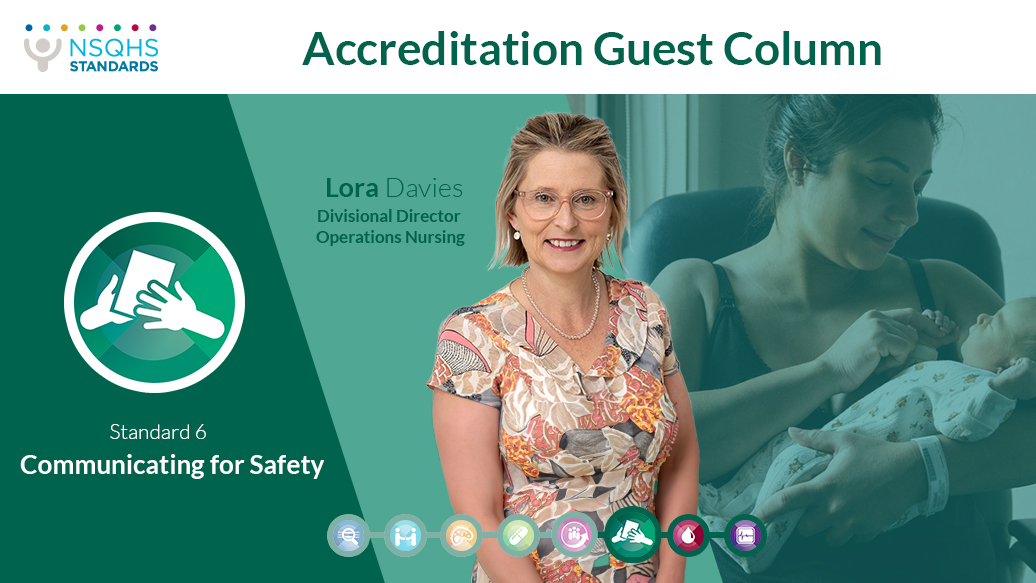
    This week we spoke to Lora Davies, Divisional Director, Sub-Acute Services & Access, about Standard 6: Communicating for Safety.

    What is this standard about?

    Standard 6 is all about Communicating for Safety. The three main areas this covers are:

    1. Patient Identification
    2. Procedure Matching
    3. Clinical handover

    But, as you can imagine, the need for clear and timely communication is required in almost every part of our organisation. We aim to ensure that the patient is provided with timely, purpose-driven and effective communication and documentation that support continuous, coordinated and safe care for patients.

    At Northern Health, this standard looks like….

    Some examples:

    • Checking patients 3 points of identification
    • Ensuring appropriate safety checklists are completed prior to procedure matching (surgery, endoscopy, ophthalmology, etc)
    • Bedside nurse handover at end of shift
    • ISBAR Handover between clinicians at points of transfer of care (ward to ward, etc)
    • Identifying and acting upon new critical information about your patient

    What are the top 5 ways staff can be prepared for Accreditation against this Standard?

    • Have a think about what the term ‘critical information’ means for your area.
    • Ensure your patients have access to bedside patient communication boards.
    • Ensure you are involving patients and carers in decision making – via effective communication.
    • Ensure your team are handing over the right information for each patient.
    • Ensure handover sheets aren’t left in public areas.

    What are the top 5 questions staff needs to be able to answer about this Standard?

    • How do you define critical information in your area?
    • How do you ensure patients are able to engage in their care and decision making?
    • What processes do you use to ensure you are identifying the patient correctly?
    • What processes do you use to ensure you are performing the right procedure on the right patient?
    • Are you ensuring your handovers are done in ISBAR format?

    Is there anything else you would like staff to know about this Standard?

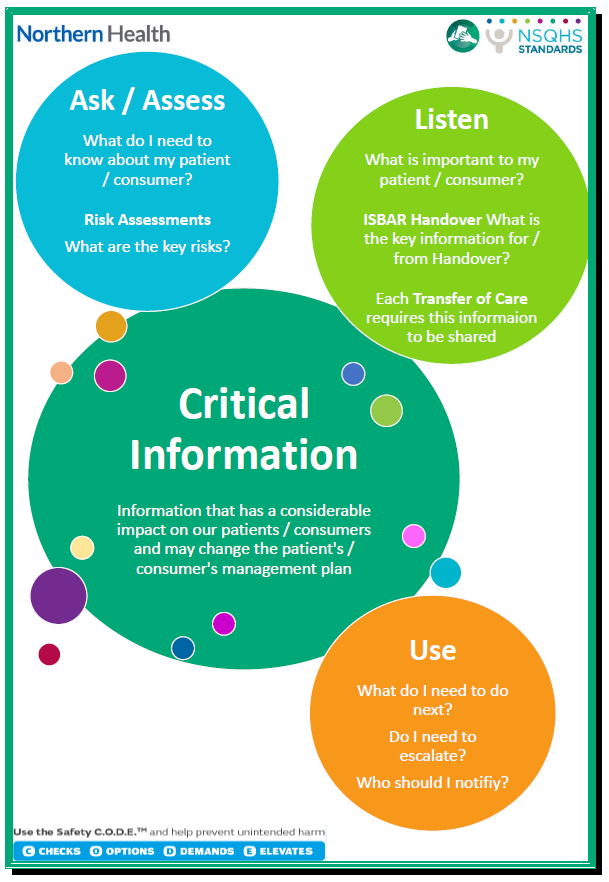
    Standard 6 has been focusing on supporting clinicians in defining ‘critical information’.

    Critical information can be something that is known (i.e. alerts/allergies), it could be something that is new information (i.e. patient mentions it at some point in their care), or it could be something that we actively seek out such as identifying risks within iView of EMR or the relevant paper based documents, or asking specific questions.

    When new critical information arises, it should be addressed as soon as possible via appropriate clinical action. We also acknowledge that critical information looks different in each setting. The below Fact Sheet has been developed to assist.
    To learn more about Standard 6, please see the Intranet.

  • Get to know: Vanessa Leonard-Roberts

    Get to know: Vanessa Leonard-Roberts

    #WeAreNorthern

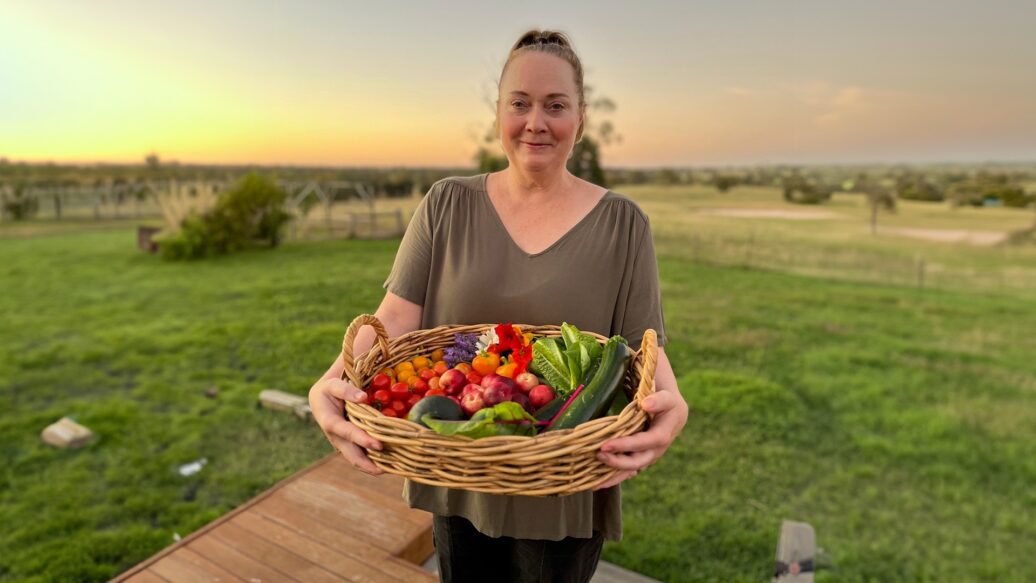
    Meet Vanessa Leonard-Roberts, Emergency Nurse Practitioner.


    Q: What is your coffee order?

    A: Skinny latte, but actually I prefer rooibos tea. It’s an African tea, full of antioxidants and caffeine free.


    Q: What does a day at work look like for yourself as an Emergency Department Nurse Practitioner?

    A: The ED is a fast-paced, challenging environment. This is no different for the ED Nurse Practitioner (ED NP). Typically, ED NPs work in the Fast Track space attending to minor/moderate illness and injuries. At Northern Health, however, the ED NPs also work to an expanded scope of practice allowing for work in various other areas of the ED. This is very exciting and provides great learning opportunities. I am also fortunate to be working with an incredible team of advanced physiotherapists, medical and nursing staff and experienced NPs that support me in my working day.


    Q: What advice do you have for other nurses considering your specialty?

    A: There has never been a better time to be a Nurse Practitioner! There is more funding and support than ever before and there is so much opportunity out there. Take the challenge!


    Q: How do you like to relax after a long shift?

    A: I live on a small cattle farm, and I have a herb cottage where I make my own preserves/ointments/ dried herbs. I will usually potter about in there or in the vegie garden after a long shift. I am also an avid reader. Nothing like a good book and a cup of tea to clear the mind.


    Q: Where is a favourite place you’ve travelled and why?

    A: I was born in Africa and recently went back to visit family. It was a wonderful trip, but they have since moved to London, so I expect that will be my next favourite place. Other than Scotland of course, I am a bit of an Outlander fan.

  • Meet Ivy: Our little Leap Day baby at Northern Health

    Meet Ivy: Our little Leap Day baby at Northern Health

    Meet Ivy, a special baby girl born on a day that comes once every four years. Expected to make her debut on 11 March, Ivy surprised everyone by gracing the world with her presence on 29 February 2024. Ivy’s parents, Sri and Prasantha, were overjoyed by her unexpected, but wonderful, arrival.

    Ivy’s mother Sri is already planning grand celebrations for Ivy every leap year, embracing nature-themed parties and a tradition of giving back. She envisions each birthday as an opportunity to spread happiness to those in need, making Ivy’s milestones truly unforgettable.

    “Ivy’s birthday on 29 February is very special as it wraps up all our family birthdays which start on 17 February. That’s why I will choose to celebrate her birthday on 28 February during non-leap years,” Sri shared.

    As Sri tenderly cradled Ivy, she reflected on her blissful pregnancy, devoid of discomfort or distress. “She is an absolute angel and a miracle baby,” said Sri, her voice filled with gratitude. She even had a dream about a baby girl before knowing she was pregnant, which turned out to be Ivy!

    For proud parents, Prasantha and Sri, Ivy is a precious gift, bringing immense joy and love into their lives. Ivy Yashodhara Silva, born on a rare day, to remind us of life’s beautiful surprises.

    From all of us at Northern Health, Happy Birthday to all Leap Day babies ❤

  • Harmonising Hearts for RedFeb’s Cardiac Cause

    Harmonising Hearts for RedFeb’s Cardiac Cause

    RedFeb is an annual event acknowledged by Heart Research Australia, that invites individuals to don the colour red in solidarity with loved ones impacted by heart disease. It serves as a beacon of hope, rallying communities to raise awareness for the prevention, diagnosis, and treatment of various heart conditions, from coronary heart disease (CHD) to heart failure, valve issues and arrhythmias.

    Northern Health Heart Failure Nurse Practitioner, Vikki Hannah, says many people may not be aware of their risk factors for heart disease, as some risk-factors, such as high blood pressure and high cholesterol, have no symptoms.

    “It’s never too late to manage your risk of heart disease and improve your heart health. Some risk factors for heart disease are beyond your control, such as age, gender, ethnicity and family history, but there is no one cause for heart disease. Most heart attacks and strokes can be prevented with healthy choices,” Ms Hannah says.

    Heart disease stands as Australia’s primary cause of death, with 18,590 fatalities attributed to it in 2017, claiming an Australian life every 28 minutes. An alarming 90 per cent of Australians possess at least one heart disease risk factor, highlighting the urgency of proactive health management. The more risk factors for coronary heart disease you have, the greater your chance of developing it.

    The good news is that for most risk factors, you can do something about them.

    Risks you can control:

    • Smoking
    • Cholesterol
    • High blood pressure
    • Being inactive
    • Diabetes
    • Being overweight
    • Unhealthy diet

    Risks you can’t control:

    • Age: As you get older, your risk of heart disease increases
    • Gender: Men are at higher risk of heart disease. Women’s risk grows and may be equal to men after menopause
    • Ethnic background: People of some origins (e.g. from the Indian sub-continent) have higher risk
    • Family history: If someone in your family has cardiovascular disease, speak to your doctor about your risk.

    Unfortunately, there are an increasing number of people presenting to the emergency department of hospitals experiencing a heart attack, with none of the traditional modifiable risk factors such as genetics, smoking, and hypertension.

    Ms Hannah also highlighted that research shows women are much less likely to undergo treatment for a heart attack or angina in hospital compared to men. Even though chest pain is a common heart attack symptom for both genders, women may experience different symptoms like back pain, vomiting or indigestion.

    “Despite the rising number of people having heart attacks without traditional risk factors, there is hope in prevention. By making healthy choices and staying informed, we can protect our hearts and the hearts of those we care about,” she said.

    For more information on RedFeb, please visit www.heartresearch.com.au/redfeb

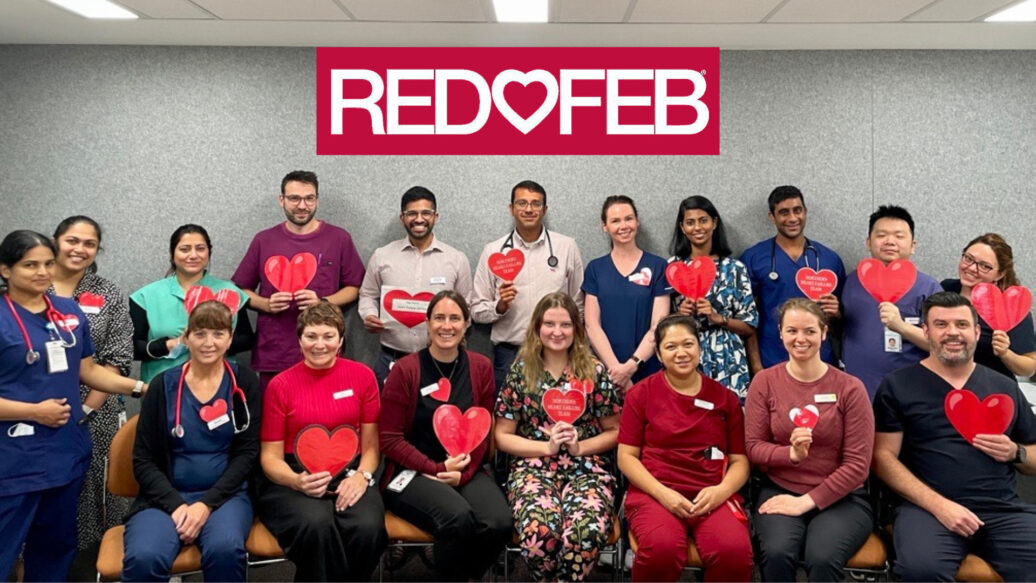
    Featured image: Cardiology team, Northern Health 

  • Setting the standard for the way we do things at Northern Health

    Setting the standard for the way we do things at Northern Health

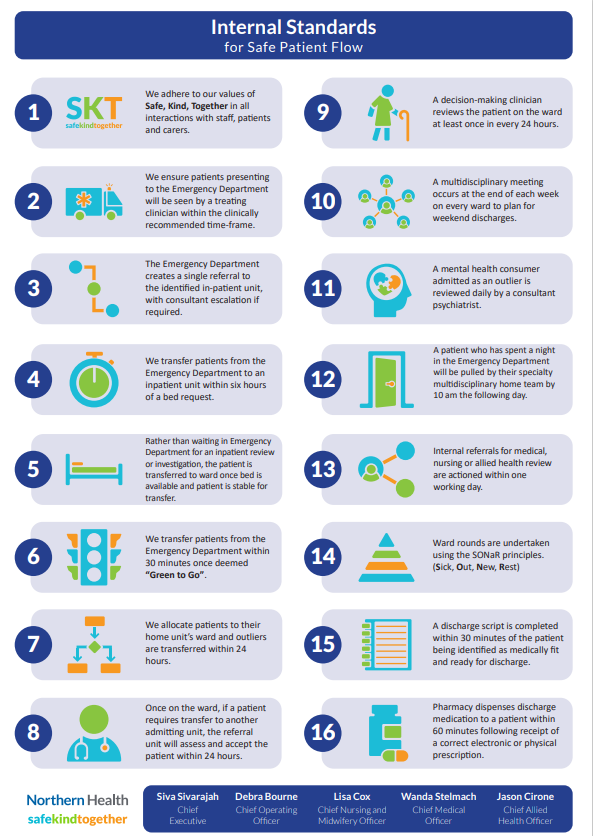
    This week, Northern Health launched the ‘Internal Standards for Safe Patient Flow.’

    These standards establish clear and unambiguous description of values and behaviours and support flow of patients, from arrival in the Emergency Department, to leaving hospital. They centre around the patient journey and process of care and help to confirm expectations and roles of staff across their journey.   

    Debra Bourne, Chief Operating Officer, officially launched these standards on Monday, 27 February 2024.

    “The Internal Standards for Safe Patient Flow set the tone for how we do things at Northern Health and will help guide our staff on how to support our patients, and each other, across the journey of inpatient care,” said Ms Bourne.

    “Through widespread consultation and extensive benchmarking, we have developed 16 standards, which align with our three values of safe, kind and together. They have been created, and agreed to, by our clinical leaders and endorsed by the Northern Health Access Committee.”

    Staff will begin to see and hear about these standards at regular staff meetings, huddles and events across the health service.

    “The power of these standards to influence safe patient flow will come from clinicians translating these into professional behaviours, and by individual staff members demonstrating these in their daily interactions with fellow staff and patients,” said Ms Bourne.

    “These standards help to confirm expectations and roles of staff across the patient journey, and I am looking forward to seeing their impact on our operations and our community.”

    Please see the below document or click here for further information.

    If you have questions about the standards, please discuss these with your direct line manager.

  • Standard 5 – What you need to know

    Standard 5 – What you need to know

    Each week in the lead up to Accreditation, Northern Health will focus on a different Standard. You will hear from the Chairs of each Standard Committee on what you need to know.

    This week we spoke to Lisa Cox, Chief Nursing and Midwifery Officer, about Standard 5: Comprehensive Care.

    What is this standard about?

    Standard 5 is aimed at ensuring patients receive care that is based on their individual care needs and considers the whole person in that care. It also aims to ensure that each patient is assessed at the beginning and during their care for any risks of harm. These risks are then mitigated though interventions developed with the patient and family.

    At Northern Health, this standard covers nine key areas:

    • Assessment and developing a comprehensive care plan
    • Providing comprehensive care at end of life
    • Preventing falls and harm from falls
    • Preventing and managing pressure injuries
    • Nutrition and hydration
    • Preventing delirium and managing cognitive impairment
    • Predicting, preventing and managing self-harm and suicide
    • Predicting preventing and managing aggression and violence
    • Minimising restrictive practices – restraint and seclusion

    What are the top 5 ways staff can be prepared for Accreditation against this Standard?

    All patients on admission need to be assessed using the admission form and risk assessments.  A care plan is then developed based on this initial assessment. It is important that all staff providing clinical care review the plan of care each day to understand each patient’s individual care requirements, identified risk(s) and ensure strategies are in place to minimise patient harm. There are specific harms that are identified in this standard and they are:

    • Pressure injuries
    • Falls
    • Poor nutrition
    • Cognitive impairment
    • Self-harm and suicide risk
    • Unpredictable behaviour

    The plan of care developed for each patient must consider these potential risks and ensure that they are protected from harm. More importantly the care plan needs to be developed with the patient ensuring decisions made about their care is shared.

    What are the top 5 questions staff needs to be able to answer about this Standard?

    • What is your patient’s/consumer’s specific goal for the day, what matters to them?
    • What does your patient/consumer want to achieve by, being in hospital or using the community (Hospital without Walls) service?
    • What is your patient’s/consumer’s risk(s)?
    • What interventions and plans do you have in place to minimise harm from these identified risks?
    • Does the patient/consumer and/or their family/carer/nominated support person understand their risks?

    To learn more about Standard 5, please see the Intranet.

  • Get to know: Dr Eric Daniel

    Get to know: Dr Eric Daniel

    #WeAreNorthern

    Meet Dr Eric Daniel, Colorectal Surgeon, Northern Health

    Q: What is your coffee order?

    A: Long macchiato.

    Q: Tell us about your role at Northern Health?

    A: I’m a Colorectal Surgeon which is a sub-speciality dealing with bowel cancer, inflammatory bowel disease, pelvic floor dysfunction and proctology. I finished medical school in 2006 and my post graduate training in 2017 and started as a consultant in 2018 at Northern Health.

    The Colorectal Unit is a part of the Division of General Surgery, and we work closely with the Gastroenterology Unit, stomal therapy, nursing staff and Allied Health.  It is a busy unit for our junior medical staff, but I think our unit culture makes it a favourable rotation. Well, I hope it does!


    Q: If you weren’t a surgeon, what would you have been instead?

    A: Either a failed writer or a terrible lawyer. In both cases, still living with my parents.


    Q: What is your biggest achievement till date (both professionally and personally)?

    A: Professionally, I feel my biggest achievement was getting through training. It’s a terrible toll your family has to pay. Personally, being lucky enough to have two children.


    Q: What is on your bucket list for 2024?

    A: Ah…. Probably getting away for the weekend for my 10-year wedding anniversary. Actually, this is quite a good reminder to book something!

  • Shaping patient-centred care: The journey of Carol Burnett

    Shaping patient-centred care: The journey of Carol Burnett

    Northern Health is committed to delivering patient-centred care. Partnering with consumers is central to ensuring that our patients and their carers are at the core of all the work we do.

    Standard 2, known as the Partnering with Consumers Standard, is about fostering a collaborative relationship between healthcare providers and those we serve. This means involving consumers in the planning, design, delivery, and evaluation of our services. It’s also about empowering patients to be active participants in their own care, giving them a say in decisions that affect them.

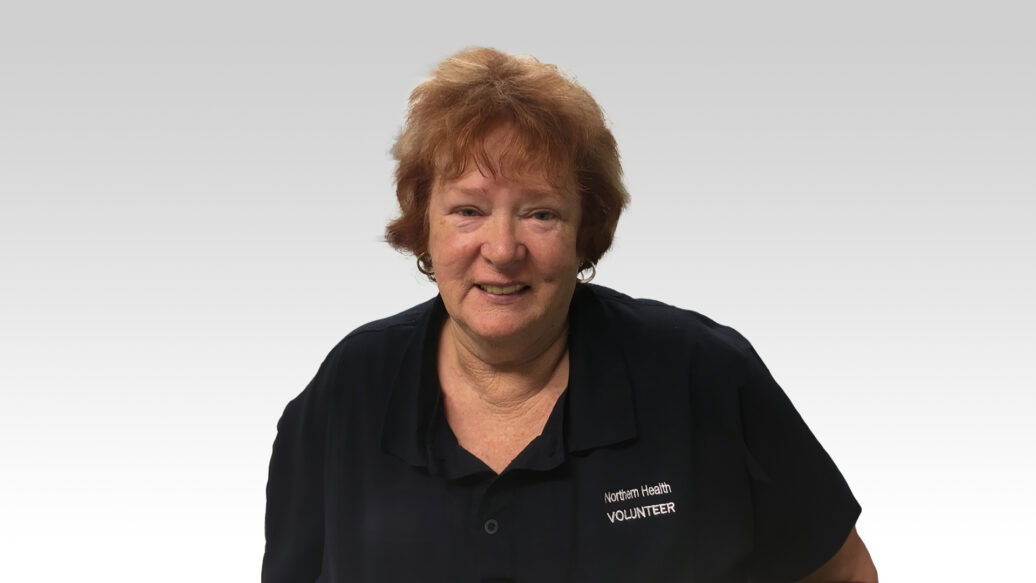
    Today, we’re excited to share the story of Carol Burnett. Carol is not only a retired nurse, teacher, educator and manager, but also a dedicated volunteer at Northern Health since 2019. She’s currently a valuable member of our Consumer Participation team, where she continues to make a difference in shaping our approach to patient-centred care.

    Q: Tell us about your professional background and some of the roles you’ve had throughout your career?

    A: I have had a range of careers, starting as a nurse in 1965. I gave up nursing to raise my two children and during that time studied to become a teacher/librarian. I taught for a while and then moved into adult education, and finally management. One of my roles was CEO of Volunteering Victoria – the peak body for volunteers – and I was a manager at The University of Melbourne for 10 years and La Trobe University for 15 years.

    Q: What is your relationship to Northern Health and how did this begin?

    A: I started as a Volunteer in 2019 and was a guide for a while, before moving to various admin tasks. I then commenced driving patients to their outpatient appointments. COVID struck and the driving program had to cease. When we were allowed to resume, I started driving at the Bundoora Centre and I do this two days a week.  I also participate in the Standard 2 Committee.

    Q: Why do you think it’s important to be involved in Consumer Participation and in what capacity do you contribute to the team?

    A: Volunteering has been a big part of my life for over 40 years, and I have been on numerous committees. As for taking part in Consumer Participation, I felt that I had the skills and the willingness to volunteer my time. I have always believed that it is more important to be part of the solution, than be the person that complains about issues within the health service. Consumer Participation allows people to do exactly that – be part of the solution and give feedback from a different perspective.

    Q: You provide valuable insights to Northern Health because of your lived experience. What does it mean to have ‘lived experience’ and how do the insights you share make a difference to the health service?

    A: There is a definition that lived experience refers to the first-hand involvement or direct experiences and choices of a given person, and the knowledge that they gain from it, as opposed to the knowledge gained from second-hand or mediated source. This fits with what I believe, and decisions made by Northern Health about consumers should always include the consumer’s viewpoint, which can often be different than those making the decisions. The National Safety and Quality Health Service (NSQHS) has set standards which Northern Health has adopted, and I believe that if you have a standard, you need to be proactive in addressing the issues. Being part of the Standard 2 Committee enables me as a consumer to be proactive.

    Q: Tell us something not many people know about you?

    A: When I was sixteen – a very long time ago – I lied about my age so that I could be a dancer at a St Kilda nightclub. My “career” only lasted for three weeks, as my brother saw me and told the manager my real age.

    Q: Is there anything else you would like to add?

    A: What I find interesting is that the past can have an influence on what we do today. My great aunt was a nurse at the Launceston General Hospital in 1908 and was involved in an incident that impacted on the patient’s wellbeing. My book on the subject has just been published, and the hierarchy of the day shows the huge gap between the way hospitals are run today and the respect and rights given to consumers.