

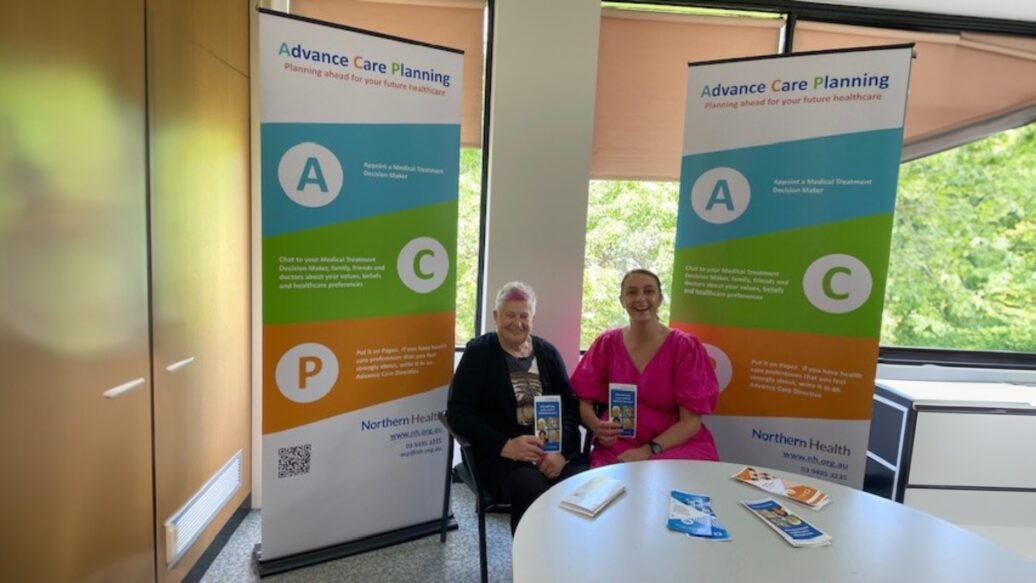
“I feel good knowing I have done it,” Diane Lonsdale, Northern Health consumer.
The National Advance Care Planning (ACP) Week runs from 18 to 24 March, and encourages people to “Share what matters most” with their Medical Treatment Decision Maker/s (MTDMs), loved ones, GP and/or Specialists. Advance Care Planning involves thinking about, talking about, and perhaps documenting future healthcare preferences, for a time when you may be unable to communicate.
The Advance Care Planning Program aims to increase awareness through engagement and supportive collaboration for people aged 18 years and over, throughout the Northern Health organisation and the community. The team consists of three staff members; A/Prof. Barbara Hayes – Clinical Lead, Ella Critchley – Advance Care Planning Program Manager and Karen Overall – Administration Support.
Recently, Ms Critchley sat down with Diane Lonsdale, a past consumer of Northern Health, to discuss her reasons for undertaking Advance Care Planning.
Q: What matters most to you?
A: For me, it’s planning and my autonomy, but above all, it’s my family. I first heard about Advance Care Planning (ACP) as a patient at Northern Health. I was interested and intrigued to know more and was given a brochure alongside a discussion with the medical team.
As time went by, I attended a community education session delivered by the Northern Health’s ACP Program Manager at my place of residence, a local retirement village. I knew this was my opportunity to complete ACP documents, after experiencing the uncertainty of illness within my family, and I just wanted to take the pressure off my family.
Q: In your opinion, what are the benefits of ACP?
A: When thinking about what happened to a family member, I reflected on previous ACP discussions. I appointed two people to be my MTDMs, people I trusted to make the medical decisions I would make for myself, and the importance of making it easier for my kids, by sharing knowledge of what I wanted.
With the help of Ella and my GP, I completed the appointment of a MTDM form and an Advance Care Directive, making it clear to my MTDMs and medical team, exactly how I wanted to be cared for, ever if I lose the capacity to provide consent. My GP discussed the forms with me and witnessed my signature.
Communicating preferences and values can be difficult, but the benefits of not having to make unprepared, in-the-moment decisions, far outweigh these difficult conversations. Reflecting on undertaking ACP, I feel good knowing I have done it and feel a sense of relief that it’s done.
“We are grateful to Diane for generously sharing her ACP story. We couldn’t agree more with Diane’s statement in which she says ‘Some people think you don’t need it. I say, ‘you do’,” said Ms Critchley.
“Being prepared and having a good understanding of a person’s preferences and values is paramount to receiving person-centred care.”
“We’re encouraging everyone during this week, and moving forward, to “Share what matters most” about future health care values and preferences!”, she said.
Contact the team:
#acpweek24 #ShareWhatMattersMost #ifnotyouwho
Pictured in featured image (L-R): Diane Londsdale, consumer and Ella Critchley, ACP Manager.